HealFern may earn a commission if you buy through links on this page, at no extra cost to you. That does not change what we report.
Part of our MenoSoothe overview. Last checked November 5, 2026.
MenoSoothe side effects have not been studied for the product itself, but its 13 herbs point to mild stomach upset as the most likely problem, with rarer liver, bleeding and thyroid risks. A search of the FDA's openFDA adverse event data on November 5, 2026 found no reports naming MenoSoothe. For its main herb, black cohosh, NIH counts at least 83 liver injury cases worldwide, with causality unproven.[3]
Is MenoSoothe safe? Safety at a glance
MenoSoothe is probably low risk for most healthy adults at two capsules a day, but it is not risk-free, and the biggest caution is the liver. Black cohosh, at 30 mg per serving, has case reports of liver failure, some needing a transplant.[2][3] A US Pharmacopeia safety assessment rated all 30 reports it examined as possible, none probable, and called for a caution on labels.[4] A meta-analysis of 5 trials in 1,117 women found no change in liver enzymes over 3 to 6 months, so the risk looks rare.[5]
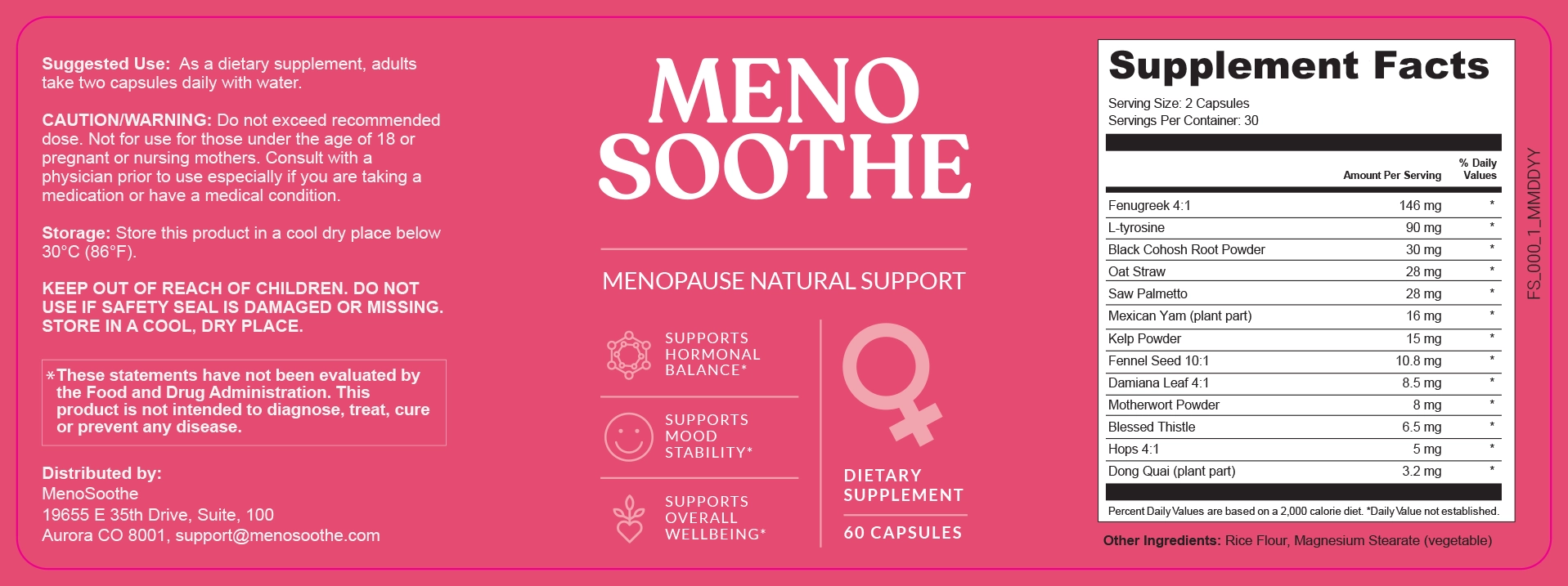
The next cautions are bleeding with blood thinners (dong quai), thyroid effects from iodine (kelp, amount not stated), and estrogen-like effects (hops).[1] The label warns against use under 18, in pregnancy and while nursing, and tells anyone on medication to ask a physician.[1] No study has tested the full MenoSoothe formula for safety.
What side effects are possible?
Most reported reactions to these herbs are mild and digestive. Allergy and drug-related effects are less common but more serious.
Digestive
Fenugreek, the largest ingredient at 146 mg, can cause diarrhea and nausea, according to NCCIH. Black cohosh trials reported mild stomach upset and rash.[12] Blessed thistle at high doses has been linked in LactMed to stomach cramps, nausea and vomiting; MenoSoothe has 6.5 mg.[10]
Sensitivity and allergy
NCCIH says fenugreek can cause allergic reactions, including serious ones. Blessed thistle belongs to the ragweed family, so people with that allergy should be careful.[10] Fennel can cross-react in people allergic to celery, carrot or mugwort.
Medication-related
Dong quai contains coumarin derivatives, and a warfarin user's INR more than doubled in a case report.[7] Large fenugreek doses may lower blood sugar. L-tyrosine interacts with several prescription drugs.[9]
Which ingredients deserve extra attention?
Five MenoSoothe ingredients have specific safety findings in our sources. The doses are small, but the label does not say how much iodine the kelp provides, and the herbs add up if you take other products with them.
| Ingredient | Safety issue | Why it matters |
|---|---|---|
| Black cohosh, 30 mg | Rare liver injury reports | NCCIH advises a provider check with liver disorders; safety uncertain after breast or uterine cancer |
| Dong quai, 3.2 mg | Coumarins, bleeding risk | Warfarin and other blood thinners |
| Kelp, 15 mg | Iodine, amount not stated | Excess iodine can trigger under- or overactive thyroid |
| Hops 4:1, 5 mg | Plant estrogen (8-prenylnaringenin) | Case reports of womb lining overgrowth; hormone-sensitive conditions |
| Motherwort, 8 mg | Stimulates the womb | Avoid in pregnancy |
Sources: black cohosh[2], dong quai[6], iodine[8], hops[11] and motherwort[13]. The hops cases involved a product with 418 mg of hop per tablet, far more than MenoSoothe's 5 mg. Our MenoSoothe ingredients page covers what each herb is.
Which medicines could interact?
Show the MenoSoothe label to a pharmacist if you take any of these medicine groups. Some interactions are documented; others are cautions based on how the herb acts.
- Blood thinners (warfarin, antiplatelets): dong quai.[6][7]
- Thyroid drugs: antithyroid drugs such as methimazole with iodine from kelp[8]; levothyroxine with L-tyrosine.[9]
- MAOI antidepressants and levodopa: L-tyrosine.[9]
- Diabetes medicines: fenugreek may lower blood sugar at large doses.
- Estrogen therapy, tamoxifen or aromatase inhibitors: hops are estrogenic, and an added effect has not been studied.[11]
- Blood pressure drugs and sedatives: motherwort is used traditionally as a sedative; no interaction study exists.[14]
For black cohosh itself, the ODS reports no known clinically relevant drug interactions, though they have not been studied systematically.[3]
Pregnancy, breastfeeding and who should ask a doctor first
Do not take MenoSoothe if you are pregnant, breastfeeding or under 18; the label says so, and motherwort can stimulate the womb.[1][13] Ask a doctor first if you:
- Have liver disease or abnormal liver tests.
- Have had breast, uterine or another hormone-sensitive cancer.[2]
- Have thyroid disease, including Hashimoto disease or nodules.[8]
- Take a blood thinner or have a bleeding disorder.
- Have diabetes and take glucose-lowering medicine.
- Have a ragweed allergy.
- Have surgery planned.
Our guide to taking MenoSoothe explains the label dose and what to avoid stacking with it.
Which symptoms need a doctor right away?
Stop MenoSoothe and see a doctor right away if you notice:
- Yellow skin or eyes, dark urine, unusual tiredness or pain under the right ribs. NCCIH names these as possible liver warning signs with black cohosh.[2]
- Unusual bruising, nosebleeds, blood in urine or stools.
- Vaginal bleeding after menopause.
- A racing heart, tremor or a swelling in the neck.
- Hives, swelling of the lips or face, or trouble breathing (call 911).
Safety conclusion
MenoSoothe's small doses make serious side effects unlikely for most women, but black cohosh, dong quai, kelp and hops each carry a caution that matters for specific groups. If you have liver, thyroid or hormone-sensitive conditions, or take blood thinners, check with your doctor before ordering. Our evidence check on whether MenoSoothe works helps you weigh those risks against the likely benefit.
Back to the MenoSoothe overview.
Frequently asked questions
Can MenoSoothe cause liver damage?
It is possible but rare. MenoSoothe contains 30 mg of black cohosh, which has case reports of serious liver injury, with causality unproven. NCCIH says to stop and see a doctor if you get dark urine, unusual tiredness or yellow skin.
Is MenoSoothe safe with thyroid problems?
Ask your doctor first. MenoSoothe contains 15 mg of kelp, an iodine source, and the label does not say how much iodine that provides. Excess iodine can trigger an underactive or overactive thyroid, especially in Hashimoto disease.
Can I take MenoSoothe with blood thinners?
Only after checking with your doctor. MenoSoothe contains dong quai, which has coumarin derivatives, and a published case report described a warfarin user whose INR more than doubled. Antiplatelet drugs need the same check.
Does MenoSoothe cause weight gain or bloating?
None of our sources links its ingredients to weight gain. The most common reported herb side effects are digestive: fenugreek can cause diarrhea and nausea, and black cohosh trials noted mild stomach upset. Stop if symptoms persist.
Is MenoSoothe safe after breast cancer?
Talk to your oncologist first. NCCIH says black cohosh safety is uncertain after breast or uterine cancer, and MenoSoothe also contains hops, a plant estrogen, plus dong quai, which stimulated breast cancer cell growth in lab work.
Sources
- MenoSoothe Supplement Facts label image. MenoSoothe, read November 5, 2026.
- Black Cohosh. NCCIH, read November 5, 2026.
- Black Cohosh fact sheet for health professionals. NIH Office of Dietary Supplements, read November 5, 2026.
- USP safety assessment of black cohosh and liver reports. PubMed, read November 5, 2026.
- Black cohosh extract and liver function, meta-analysis of 5 trials. PubMed, read November 5, 2026.
- Dong Quai. NCCIH, read November 5, 2026.
- Dong quai and warfarin interaction case report. PubMed, read November 5, 2026.
- Iodine fact sheet for consumers. NIH Office of Dietary Supplements, read November 5, 2026.
- Tyrosine. MedlinePlus, read November 5, 2026.
- Blessed Thistle, LactMed. NCBI Bookshelf via PubMed, read November 5, 2026.
- Endometrial hyperplasia with a hop menopause supplement, case reports. PubMed, read November 5, 2026.
- Black cohosh side effects in clinical studies. PubMed, read November 5, 2026.
- Leonurus (motherwort) and uterine activity in 121 women. PubMed, read November 5, 2026.
- Motherwort oil extract in hypertension with anxiety. PubMed, read November 5, 2026.
This page is general information, not medical advice. Dietary supplements are not reviewed by the FDA for safety or effectiveness before they are sold and are not intended to diagnose, treat, cure or prevent any disease. Talk to your doctor before taking any supplement, especially if you are pregnant, nursing, take medication or have a health condition.