HealFern may earn a commission if you buy through links on this page, at no extra cost to you. That does not change what we report.
Part of our MenoSoothe overview. Last checked November 5, 2026.
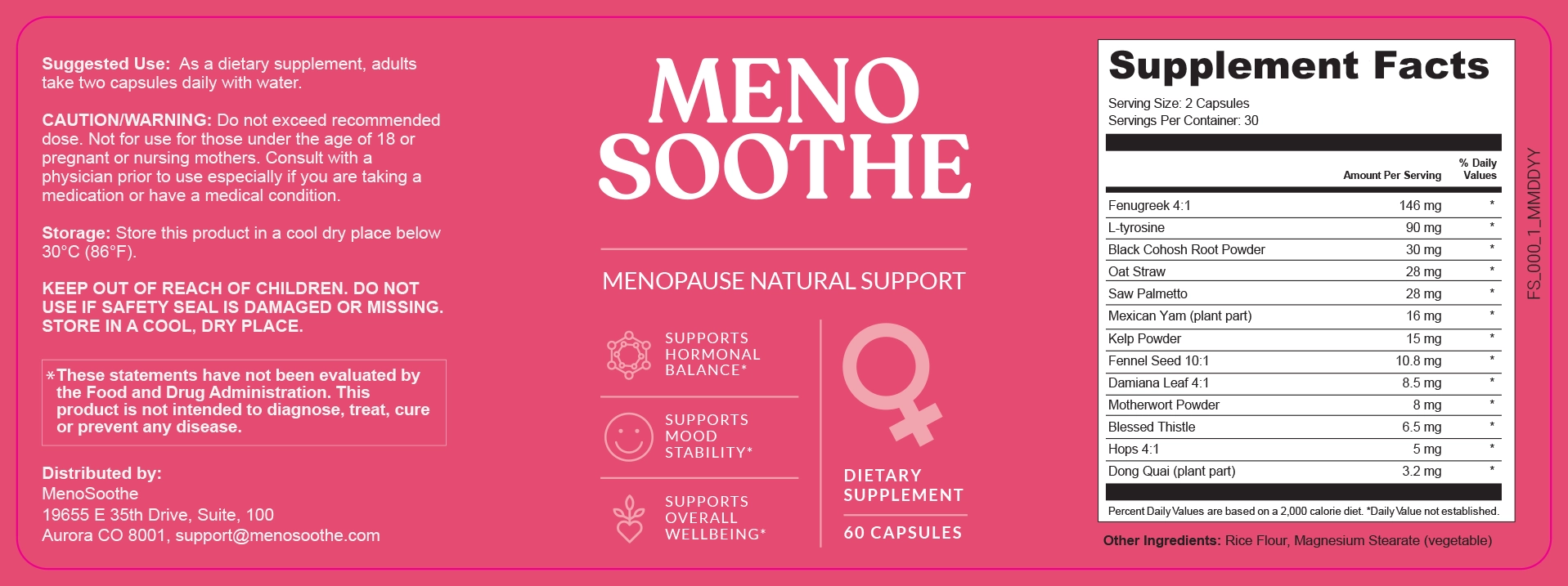
Meno Soothe ingredients, per the bottle label: 13 herbs and the amino acid L-tyrosine, totaling about 395 mg in each 2-capsule serving, with every amount printed.[1] The two herbs with the most menopause research are fenugreek (146 mg of a 4:1 extract) and black cohosh (30 mg of root powder). A Cochrane review of 16 black cohosh trials in 2,027 women found no difference from placebo in hot flush frequency.[3]
MenoSoothe ingredients at a glance
MenoSoothe contains fenugreek, L-tyrosine, black cohosh, oat straw, saw palmetto, Mexican yam, kelp, fennel seed, damiana, motherwort, blessed thistle, hops and dong quai. Only three come with a specific vendor claim on its sales page.[2] Grades are ours and refer to menopause symptoms.
| Ingredient | Vendor's stated role | Amount per serving | Evidence grade |
|---|---|---|---|
| Fenugreek 4:1 extract | "Hormonal balance" | 146 mg | Limited; trial used 600 mg/day |
| L-tyrosine | Not recorded | 90 mg | None for menopause |
| Black cohosh root powder | "Occasional hot flashes" | 30 mg | Limited, conflicting |
| Oat straw | Not recorded | 28 mg | None for menopause |
| Saw palmetto | Not recorded | 28 mg | None for menopause |
| Mexican yam | "Menopausal health" | 16 mg | None (one null trial) |
| Kelp powder | Not recorded | 15 mg (iodine not stated) | None for menopause |
| Fennel seed 10:1 | Not recorded | 10.8 mg | None for menopause |
| Damiana leaf 4:1 | Not recorded | 8.5 mg | Weak |
| Motherwort | Not recorded | 8 mg | None |
| Blessed thistle | Not recorded | 6.5 mg | None |
| Hops 4:1 | Not recorded | 5 mg | Limited, small trials |
| Dong quai | Not recorded | 3.2 mg | None (null trial) |
What is in each ingredient, and what does research say?
For nearly every MenoSoothe ingredient, the label amount is a small fraction of what human studies used.
Fenugreek 4:1 extract, 146 mg
The fenugreek menopause trial in our sources used 600 mg a day of a proprietary extract, about four times the MenoSoothe amount, and the vendor says only that it "may help support hormonal balance".[2] NCCIH lists diarrhea and nausea as side effects.
L-tyrosine, 90 mg
L-tyrosine is an amino acid found in protein foods. Research on it covers mental performance under acute stress at 100 to 300 mg per kg of body weight, roughly 7 to 20 g in one dose. We found no menopause trial.[13]
Black cohosh root powder, 30 mg
Black cohosh results conflict: the Cochrane review found no hot flush benefit over placebo, while a 2023 analysis of 22 trials, many mixing it with other herbs, reported better overall symptom scores.[3][4] Trials used extracts at 8 to 160 mg a day, median 40 mg, not plain powder.[3]
Oat straw, 28 mg
Oat straw trials tested branded green oat extracts at 430 to 1,600 mg a day for short-term thinking speed, with mixed results, and none measured menopause symptoms.[11]
Saw palmetto, 28 mg
Saw palmetto berry is studied almost only for men's prostate symptoms, and NCCIH concludes it is probably not helpful even there.[10] We found no menopause trial.
Mexican yam, 16 mg
The label does not give a species. Wild yam contains diosgenin, which the body cannot turn into estrogen, progesterone or DHEA. The only placebo trial, a wild yam cream in 23 women, found no effect on hot flashes or hormone levels.[6] NCCIH says no conclusions can be reached.[7]
Kelp powder, 15 mg
Kelp is a seaweed and an iodine source; the label does not state its iodine content. NIH sets the adult upper limit for iodine at 1,100 mcg a day from all sources.[12]
Fennel seed 10:1, 10.8 mg
Fennel trials focus on period pain, where a meta-analysis of 12 small trials found less pain than placebo but flagged likely publication bias.[14] We found no menopause trial.
Damiana leaf 4:1, 8.5 mg
Damiana, a traditional libido herb, has human data only from combination products, so no effect can be pinned on it.
Motherwort, 8 mg
Motherwort has no menopause trial. One uncontrolled study gave 1,200 mg a day of an oil extract to 50 people with high blood pressure and anxiety.[15]
Blessed thistle, 6.5 mg
Blessed thistle has no human clinical trial for any use. LactMed notes a ragweed-family allergy risk.[16]
Hops 4:1, 5 mg
Hops contain 8-prenylnaringenin, a strong plant estrogen. An Iranian trial of 120 women found fewer hot flashes at 12 weeks; a crossover pilot did not.[8] Case reports used 418 mg of hop per tablet.[9]
Dong quai, 3.2 mg
Dong quai is a Chinese root. A trial of 71 postmenopausal women at about 4.5 g a day found no hot flash benefit.[17] MenoSoothe has 3.2 mg.
How transparent is the MenoSoothe formula?
The label itself is open: MenoSoothe prints every dose and uses no proprietary blend, which lets you do the arithmetic.[1] Fenugreek and L-tyrosine add up to 236 mg, 60% of the 395 mg serving. The other 11 ingredients share about 159 mg, and ten of the 13 herbs sit under 30 mg each.
The vendor's marketing is less consistent with the bottle. Its affiliate pitch says the formula raises DHEA, the "Youth Hormone", with maca, tribulus and ginseng; none of the three is on the label, and no label ingredient is DHEA.[18] The reference list on its sales page includes five men's prostate studies and papers on herbs the product does not contain.[2]
If a third-party list differs, trust the label, which we read on November 5, 2026.
Ingredient safety and interactions
Three ingredients carry the main cautions. Black cohosh has rare case reports of serious liver injury, and NCCIH says to stop and see a doctor with dark urine or yellow skin.[4] Dong quai has coumarin derivatives and a case report of a warfarin interaction. Kelp adds an unstated amount of iodine, which matters with thyroid disease.[12]
Hops are estrogenic: two women developed a thickened womb lining and bleeding on a hop menopause product.[9] L-tyrosine interacts with MAOIs, levodopa and levothyroxine.[13] The full list sits on our MenoSoothe side effects page, and dosing is on our how to take MenoSoothe guide.
Do these ingredients prove MenoSoothe works?
No. No trial has tested the MenoSoothe formula, and the ingredient studies used different forms at much higher doses. The ODS summary notes that The North American Menopause Society calls herbs such as black cohosh "unlikely to be beneficial" for hot flashes.[5]
Ingredient research can tell you what is plausible. It cannot show what 30 mg of black cohosh powder plus small amounts of 12 other items does. Our evidence check on whether MenoSoothe works sets out what can and cannot be concluded, and the MenoSoothe legitimacy check covers the seller.
Back to the MenoSoothe overview.
Frequently asked questions
What are the ingredients in Meno Soothe?
Fenugreek 4:1 extract 146 mg, L-tyrosine 90 mg, black cohosh root 30 mg, oat straw 28 mg, saw palmetto 28 mg, Mexican yam 16 mg, kelp 15 mg, fennel, damiana, motherwort, blessed thistle, hops and dong quai, about 395 mg per 2 capsules.
How much black cohosh is in MenoSoothe?
MenoSoothe has 30 mg of black cohosh root powder per 2-capsule serving. Trials in the Cochrane review used extracts at 8 to 160 mg a day, median 40 mg, and that review found no hot flush benefit over placebo.
Does MenoSoothe contain DHEA?
No. The label lists no DHEA, and the maca, tribulus and ginseng named in the vendor affiliate pitch for raising DHEA are not on the label either. Mexican yam contains diosgenin, which the body cannot turn into DHEA.
Does MenoSoothe have a proprietary blend?
No. MenoSoothe prints the amount of every ingredient, which is better than a hidden blend. The label does not state the iodine content of its 15 mg of kelp, or the species of Mexican yam used.
Is there iodine in MenoSoothe?
MenoSoothe contains 15 mg of kelp powder, a natural iodine source, but the label does not say how much iodine that gives. People with thyroid disease or on thyroid medicine should ask a doctor before taking it.
Sources
- MenoSoothe Supplement Facts label image. MenoSoothe, read November 5, 2026.
- MenoSoothe sales page with ingredient notes and references. MenoSoothe, read November 5, 2026.
- Black cohosh (Cimicifuga spp.) for menopausal symptoms, Cochrane review. PubMed, read November 5, 2026.
- Black Cohosh. NCCIH, read November 5, 2026.
- Black Cohosh fact sheet for health professionals. NIH Office of Dietary Supplements, read November 5, 2026.
- Wild yam cream in menopausal women, placebo-controlled crossover trial. PubMed, read November 5, 2026.
- Menopausal Symptoms and Complementary Health Approaches. NCCIH, read November 5, 2026.
- Hop tablets for early menopause symptoms, randomized trial. PubMed, read November 5, 2026.
- Endometrial hyperplasia with a hop menopause supplement, case reports. PubMed, read November 5, 2026.
- Saw Palmetto: Usefulness and Safety. NCCIH, read November 5, 2026.
- Green oat extract and cognition, systematic review. PubMed, read November 5, 2026.
- Iodine fact sheet for consumers. NIH Office of Dietary Supplements, read November 5, 2026.
- Tyrosine. MedlinePlus, read November 5, 2026.
- Fennel for primary dysmenorrhea, meta-analysis. PubMed, read November 5, 2026.
- Motherwort oil extract in hypertension with anxiety. PubMed, read November 5, 2026.
- Blessed Thistle, LactMed. NCBI Bookshelf via PubMed, read November 5, 2026.
- Dong quai in postmenopausal women, double-blind trial. PubMed, read November 5, 2026.
- MenoSoothe affiliate page. MenoSoothe, read November 5, 2026.
This page is general information, not medical advice. Dietary supplements are not reviewed by the FDA for safety or effectiveness before they are sold and are not intended to diagnose, treat, cure or prevent any disease. Talk to your doctor before taking any supplement, especially if you are pregnant, nursing, take medication or have a health condition.